There’s something thrilling—and a little terrifying—about writing magical fight scenes where battles that take place hundreds of feet in the air. Especially when pegasi are involved. Especially when those battles don’t just feature arrows and blades—but illusion spells, shadowy fae like sylphs and maybe wyverns, magical compasses, and sometimes enigmatic marble giants…
Welcome to a typical morning in front of my desk or maybe inside my brain while I’m out and about.
In the Heart of the Worlds series, I’ve written scenes where pegasi riders spiral through cloudbanks with hordes of minature smoke-wrapped skeletons on their tails, and also forced to fight a pack of wyverns over the dead-looking Grashbear Mountains.
This is place where the wind howls and magic can collide with mortal will. This is where danger lurks not just from the attack but the real possibility of a terrible plunge. But here’s the thing no one tells you when you sit down to write a sky battle. It’s not just about who wins.
It’s about balance. Emotion. Movement. And clarity. Especially clarity because when everyone is in motion. Arrows are being loosed. Spells being cast. Telepathic speech going on… and honestly, it’s easy to lose the thread.
So today, I’m lifting the veil (or should I say—spreading the wings?) on what it’s really like to write those larger-than-life scenes.
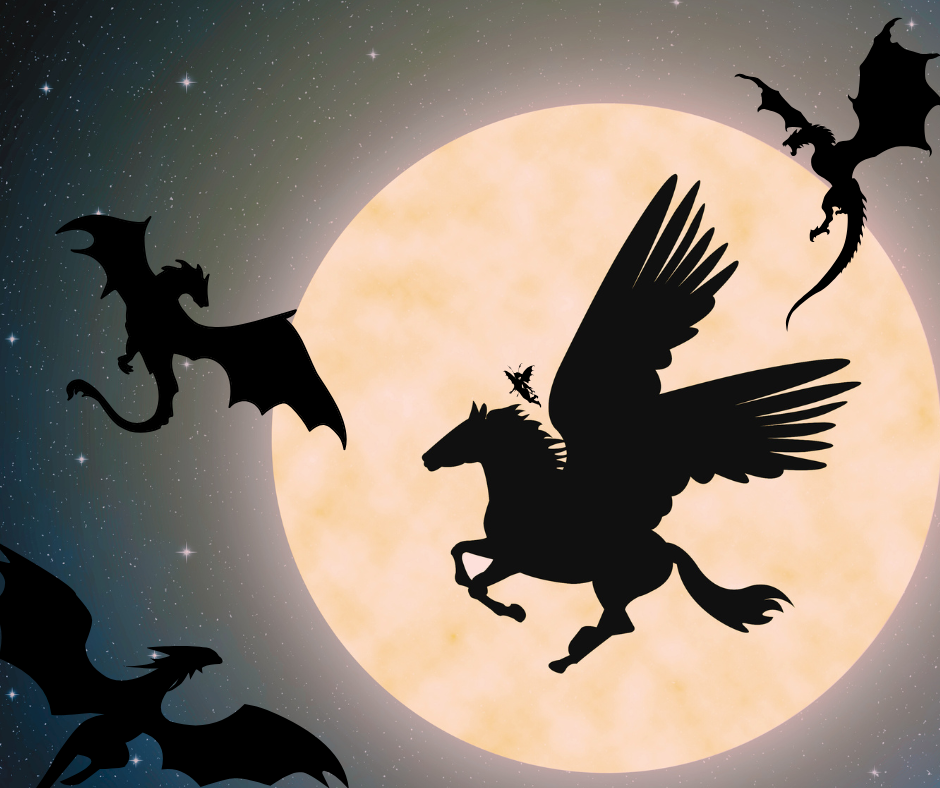
🐎 1. The Sky Is a Battlefield (and a Character)
When I write pegasi scenes, the sky isn’t just a backdrop—it’s a breathing, shifting entity. Wind changes direction and its currents can help or hinder. Clouds obscure vision or provide temporary hiding spots. Altitude affects stamina, along with fingers that might not be as nimble because of the cold. Storms can be obstacles or weapons. Etc.
I often start by storyboarding the aerial landscape, by asking:
- What are the abilities of the combantants… both the strengths and the limitations.
- Strategy. What are they’re favorite ways to attack. Are they more defensive and wait for opportunity? Do they like dive-bombing? Are they turn quick in the air?
- Are they dodging cliffs, clouds, or magical barriers?
- Who is communicating with who. How? What gets miscommunicated.
Being someone who has been in probably hundreds of melees with my rapier and dagger…
[Yes, for real though this is done safely because while we want to “k*ll” the enemy, we don’t want to hurt anybody. I’ve been in battles from two on a side to hundreds on a side. This is through the Society of Creative Anachronism (SCA), particularly the Pennsic War, which is happening Pennsylvania the beginning of August every year. It’s an event that draws 10,000-14,000 attendees.]
…I’ve learned how to read a field, different strategies to use and defenses, and how things can quickly turn chaotic.
Anyway, the fae magic in my worlds—there is both a mortal world and faery world—often heightens this. Spells can ripple through the wind or disguise movement in illusions. Magic can also literally bends the air itself. The whole process is exhilarating as I choreograph the scene.
💥 2. Timing the Magic
One of the most common fantasy writing pitfalls? Forgetting the rules of your magic system mid-battle.
Magic in Heart of the Worlds isn’t infinite. It has rhythms, sources, costs.
For instance, Bibb’s compass which gets more page time in the upcoming Faeries Don’t Hide doesn’t just whisper directions—it manipulates and also, in certain hands, is manipulated. The astrolabe, which has been teased in earlier books, reacts to celestial timing. And certain things manifested between the worlds may flicker between in and out of existence if emotions of a faeblood or potential Chandarion surge too far.
In fast-paced battle scenes, anchoring the magical rules is crucial. It’s important to remember who can do what and who can’t.
After all, magic easily can raise the stakes. But magic should never be a cheat code.
😱 3. The Challenge of Chaos
Fights are messy. Emotions run high. And not everyone makes it out unscathed.
I love showing how characters change mid-battle. How the air stings a little more when you’re flying next to someone you love. How fear can unlock power—or freeze it. How a bad call leads to very real consequences.
In Faeries Don’t Lie, one of my favorite sky sequences involved a desperate decision that cost my protagonist something they couldn’t get back. It was an internal wound that she’d carry with her into Faeries Don’t Forgive and to some pretty weighty scenes that not only deepened the magic of the world but also the emotional core of the books.
There’s a cost to writing these things. It can make you emotionally drained, and even make you cry. Yep, I’ve done both. Multiple times. Will experience it again too. But it also tells me when I’ve hit the right note.
🧚 4. When the Faery World Crashes In
Battles don’t always stay in the mortal world. And faery magic? It doesn’t play fair.
There are moments where reality frays. Where time folds. Where one of the fae shifts in mid-battle—not to save, but to test. These moments are tricky, because they require clarity and mystery at once. I want readers to feel wonder, but also dread.
So I ask myself:
- What would this look like if you didn’t understand what was happening?
- What do the characters feel even if they can’t name it?
- When do they get the clue? What do they do with? How is the reader affected?
The result, I hope, is that signature Heart of the Worlds blend of awe and tension.
🗡️ Final Thoughts: It’s Worth the Whirlwind
Writing pegasi battles and faery magic is hard. It’s intense. It demands precision, pacing, and poetry.
But when it lands?
When the wind roars, the stars burn, and my characters fight not just for survival—but for each other? Yeah….it’s part of everything I love about fantasy. And it plays into what I know by taking the field for re-enactment. Not re-enacting specific battles. No. It’s re-enacting what they may have done and with the goal to win the battle and gain the “war point.” Because it’s also a game too… like chess but with steel. And one thing I’ve learned is any good plan (or bad for that matter) all falls apart in less than five minutes.
So here’s to the pegasi flyers, the faeblood hearts who dare to soar, and the determination of heroes to continue forward even when everything is being blasted around them.