Every hero needs an anchor—someone steady, loyal, and deeply human. In the Heart of the Worlds series, that person is Mathias. His personality type, ISFJ, colors everything he does, from his devotion to his friends to the way he wrestles with guilt, loss, and love.
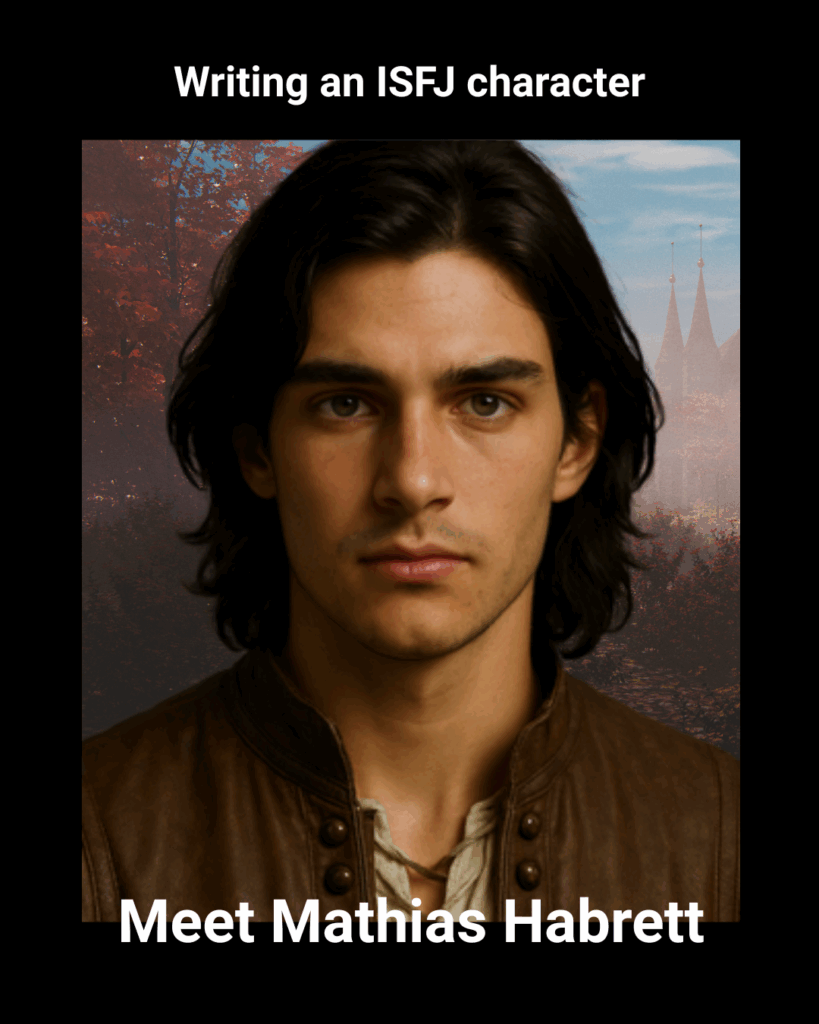
Mathias may not be the loudest or most flamboyant character, but he is one of the most layered. He embodies the ISFJ “Protector” archetype, and yet, the wounds of his past make him more vulnerable—and more determined—than anyone realizes.
I will say, unlike Aunia, Mathias did NOT show up fully formed on the page. Instead he resisted allowing me to get to know him. I do like interviewing my characters so I get to know and understand them but he wasn’t letting me in… so… after getting rebuffed countless times, I asked Aunia and Keston (Mathias’ sidekick) about him. They were all too happy to tell me all about Mathias and it didn’t take too long before he jumped in to say “Hey now!” He’s been a little more open since then.
The ISFJ: Protector with Scars
ISFJs are often called the “Protectors” of the Myers-Briggs world. As a whole they tend to be practical, compassionate, and devoted to the people they care about. Mathias embodies this at his core. Where Aunia’s INFP heart leads her toward intuition, ideals, and possibilities, Mathias steadies the path with duty, tradition, and quiet perseverance. But for Mathias, his drive to protect is as much a wound as it is a gift. And he has quite a few wounds.
Mathias was only ten when his little brother vanished while under his watch. The body was never found but he is presumed dead. Mathias has been carrying that guilt ever since. It’s shaped who he is at a core level. Basically, he believes that no matter what he does, he has already failed his family in the worst way possible. That loss severely cracked his self-esteem, and then add onto it other tragedies. Yes, Mathias is determined to be steady for others but deep inside he’s still a boy who believes he wasn’t enough.
But still he soldiers on. He stands guard—sometimes literally with sword in hand, other times by offering a quiet word or steadfast presence when others falter. His sense of responsibility makes him a natural caretaker. Yet, beneath that calm exterior, he wrestles with doubts about whether he can protect those he loves.
Duty, Exile, and the Wild Anchor
Mathias’ life is a tangle of duty, loss, and unexpected bonds. His father insists he compete in the suitor games for the heir princess’s hand—a girl Mathias finds manipulative and untrustworthy. Winning her favor would restore his family’s honor and, in his father’s eyes, make up for the brother he failed to protect. Yet Mathias knows he could never love her, nor believe she could love him for who he truly is. The weight of that obligation only deepens his distrust of love itself. A belief greatly influenced by his parents’ horrid marriage.
When betrayal and political maneuvering leads to his banishment to the Grashbear borders, Mathias loses his place, his mentor, and the sisterly bond he once shared with Nyrissa. However, that exile became the path that led him to Aunia’s village—and to a new sense of belonging he never expected to find.
Through it all, one presence has never faltered: Tafiriel, the wild Pegasus stallion who chose Mathias five years earlier. Taf is more than a mount—he is Mathias’ mirror and anchor, fierce and untamed yet loyal to the bone. In moments when guilt threatens to crush him or claustrophobia drives him toward panic, it is Taf who steadies him, reminding him that trust and freedom can exist side by side.
Together, these forces—family duty, exile, and the bond of pegasus and flye—forge Mathias into who he is: a young man scarred by expectation but strengthened by the loyalty of the few he dares to trust.
Strengths in the Story
- Loyalty and Duty – Mathias doesn’t abandon people. His word means something, and when he makes a promise, he will see it through no matter the cost. Even when exhausted or afraid, he shows up—again and again. This consistency makes him the person others lean on, whether in the heat of battle or in the quiet moments when despair threatens to win. His loyalty is not grand or flashy; it is steady, like a stone foundation that can weather any storm.
- Practical Wisdom – While others chase visions of what could be, Mathias is rooted in what is. He has a way of cutting through chaos with simple truths, reminding those around him what needs to be done now. This grounded approach is especially important for Aunia especially when her INFP heart soars toward ideals and possibilities. Mathias steadies her with the reality in front of them. His practicality does not diminish dreams—it gives them a foothold in the real world.
- Empathy in Action – Mathias’ kindness isn’t expressed in flowery speeches or dramatic gestures. It’s found in the quiet ways he notices and responds be it a reassuring word when fear trembles in someone’s voice, sharing food when he senses someone hasn’t eaten, or taking on an extra burden so another can rest. He sees the small things others overlook and quietly meets those needs. For Mathias, empathy is not abstract—it is lived, tangible, and woven into everything he does.
Shadows of an ISFJ Hero
- Self-Sacrifice & Guilt – Mathias carries the disappearance of his younger brother like an invisible weight. That guilt bleeds into his choices and makes him feel as though he must redeem himself by sacrificing his own happiness, even when close friend’s encourage him by telling he has only one life. Whether it’s bending to his father’s will, risking his safety for others, or refusing to acknowledge his own needs, Mathias often believes the only way to atone is through self-denial.
- Distrust of Love – Despite growing up in the shadow of his parents’ legendary romance, Mathias has seen the truth behind the curtain: his father’s infidelity, his mother’s bitterness, disappointment, and disillusionment. For him, love feels like a trick. It’s something beautiful in stories, but unreliable in reality. Even when he finds himself falling for Aunia, he doesn’t trust it. He fears it could unravel, betray, or destroy him as it did his mother. His guardedness makes intimacy difficult but still his heart longs for it.
- Pressure and Temper – Mathias strives to be calm, dependable, and composed, but when the pressure mounts too high, the cracks show. Too many expectations like his father’s demands, his family’s legacy, the weight of protecting Aunia, the loss of his mentor… and then added stress that his recent adventures have led him pushes him, at times, into a corner. His temper flares when he’s overwhelmed and he can become restless or even claustrophobic—desperate for a way out. These occasional outbursts while rare are revealing by showing just how much he suppresses in his effort to appear steady.
These strengths and shadows are often the same coin, just different sides. His loyalty makes him steadfast, but it also keeps him bound to guilt he doesn’t deserve to carry. His practical wisdom helps others find their footing, but it can make him resistant to change or blind to new possibilities. His empathy moves him to care deeply, but it often means he neglects his own needs until the pressure breaks.
Writing Mathias as an ISFJ
When I write Mathias, I write from the heart of an ISFJ: someone steady, cautious, and deeply loyal, but also someone shaped by wounds that never fully faded. His inner voice is observant and practical. He pays attention to the small details others might miss and these quiet observations drive his actions, often in ways that go unnoticed.
But this isn’t all that Mathias i. Like many ISFJs, Mathias has an iron will when pushed too far. His calmness can shift into unshakable resolve, a strength that surprises even those closest to him.
I do like using the Car Model with Myers-Briggs. This philosophy is taking the mental processes and relating it to a car where the driver is is the part you trust most—who is in the driver’s seat. The Co-Pilot balances the journey if you are living life in a mentally healthy plane. In the back, the Tertiary is quieter. Sometimes helpful, sometimes overlooked… and it can try to overcompensate when under stress. And finally there’s the Backseat passenger, basically your little kid in the car seat who can throw off the ride when stress builds.
For Mathias, this car explains A LOT about his inner world and why he is so layered:
- Driver: Introverted Sensing (Si) — The Archivist
Memory, tradition, stability, lived experience. Mathias’ past—his brother’s disappearance, his father’s betrayal—shapes how he views duty and trust. And then the loss of his mentor, Dar Zeller. All of it sits heavily, steering his life more than he admits. These memories don’t just inform his choices. They anchor him, and sometimes too tightly. - Co-Pilot: Extraverted Feeling (Fe) — The Caregiver
Empathy, harmony, compassion, social responsibility. This is where Mathias shines the most clearly in the story. He is deeply tuned into others. He will ground Aunia (and others he cares for) when emotions threaten to spiral. For Mathias, care isn’t theoretical—it’s lived. He would rather endure hardship himself than watch someone he loves suffer. This is the function that makes him honorable, dependable, and deeply human. - Tertiary: Introverted Thinking (Ti) — The Analyzer
Logic, problem-solving, quiet reasoning. This function is less natural for him, but it gives Mathias the tools to puzzle through problems when needed. His time with Dar Zeller studying the broken augury awakened this side of him, giving him purpose and a sense that he truly mattered. He doesn’t reach for logic as his first tool, but when he does, it’s sharp and precise. - Backseat: Extraverted Intuition (Ne) — The Storm of Possibilities
Endless what-ifs and unpredictability. This is Mathias’ weakest function, and it often shows up in ways that destabilize him. The “what ifs” haunt him, feeding his guilt and his claustrophobia when pressure builds. Aunia, with her leaps into possibility, both unsettles and inspires him. She pulls him toward risk, growth, and love—but for Mathias, all of those are terrifying places to be.
Together, these functions explain why Mathias is both strong and scarred. He is a protector shaped by memory, driven by empathy, sharpened by quiet analysis, and tested by overwhelming possibilities. His story is not just about swinging a sword or flying with Tafiriel—it’s about learning how to trust love, release guilt, and step into a future that feels uncertain. And for an ISFJ, that may be the bravest journey of all.
INFP + ISFJ: Aunia and Mathias
The balance between Aunia (INFP) and Mathias (ISFJ) is both tender and fraught. She believes in ideals and possibilities. He clings to duty and fears the weight of loss. She urges him to leap when he hesitates; he grounds her when her impulsive heart threatens to run wild.
Sometimes their differences spark conflict—Aunia might see Mathias as overcautious, while he sees her choices as dangerous. But together, they make each other better. She reminds him that love can be real. He reminds her that loyalty is as powerful as magic.
At their best, they balance each other’s worlds:
- She offers him hope when he’s drowning in guilt.
- He offers her stability when her emotions overwhelm her.
Neither of them is perfect, but together, they are stronger.
The Heart of Mathias
At his core, Mathias represents a theme woven throughout Heart of the Worlds: the quiet power of loyalty and love. While others may blaze with brilliance, prophecy, or magic, Mathias reminds us that sometimes the strongest force is simply standing by someone’s side, refusing to let them face the darkness alone. And perhaps too, even if we feel alone… perhaps we are not seeing all those who do love us.