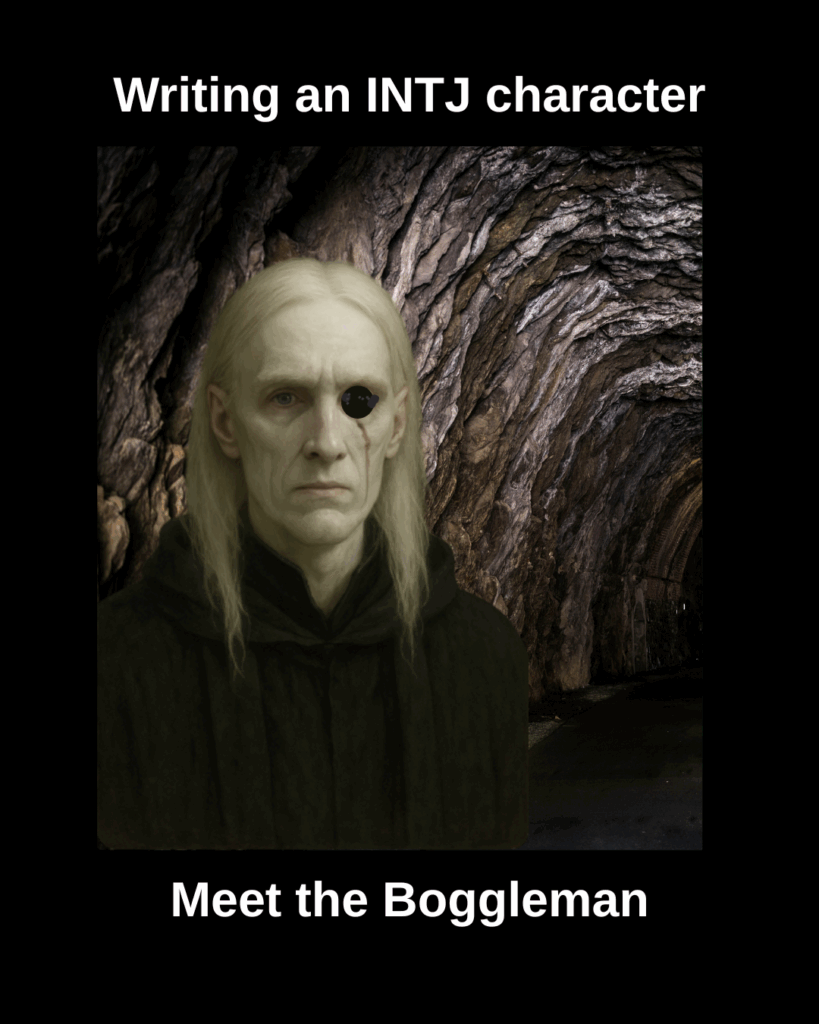
Every villain begins somewhere. For Pogonias Cromis—better known as the Boggleman, it began in a fishing village many centuries earlier.
Abandoned by his mother (and that is a story in of itself), he was adopted and raised by a widow from a fishing village. She taught him patience, hard work, and quiet loyalty. However, he also carried a strange darkness, a curiosity too sharp for comfort. He cut open animals, studied faeries, and asked questions no boy was meant to ask.
When fear of rose in the village—the villagers believed a season of bad luck came from the faeries in protest—they came to drive him out. His mother stood in his defense and she was struck down. With his mother dead at his feet, Pogonias broke. With his rage unbound, his full magic surged forward, and he destroyed the village in one terrible sweep.
From that day, Pogonias was no longer a boy but he became a shadow of what might have been. A dark presence who put his mark on several lands before he disappeared into the space between the worlds.
Now he is the Boggleman and his cloak—woven from the very fabric that separates faery and mortal worlds—wraps around him. The item consumes faeries and changes forms. It drinks power and magic from others. It transfers that power to the Boggleman. And during the Boggleman’s time in-between the worlds, within his kingdom of Nonderu, he has been searching for Chandarions and potentials to encase in Chand Ice columns.
The reason?
To utilize their power both for himself and to bleed their magic into a vast reservoir beneath his throne. He means to use the extra magic stored there to tilt the choice of the prophecy and weigh survival toward the faery world.
Shortly after Aunia’s birth, the Boggleman has been sensing new Chandarion power roaming the mortal world. He’s been searching for the source. Part of it, he realizes comes from 16-year-old Aunia. The Boggleman means to claim her and hold her inside one of the Chand Ice columns. It’s the same fate he conjured for the last Chandarion potential. He has no problem with using his faery minions: mockmen trolls and fire salamanders to help. Now does he mind unleashing toothy heebles as a weapon to destroy.
What makes the Boggleman most terrifying is not his power but his clarity. His mind sees patterns others cannot. His vision reaches where others only stumble. And he believes he is not cruel, only inevitable. One world is meant to survive and he will make sure it’s the faery one.
The Boggleman’s Car Model – (INTJ – The Visionary Turned Devourer)
Like the other major figures in Heart of the Worlds, the Boggleman can be understood through the lens of the Myers-Briggs Car Model—the four cognitive “seats” that steer personality.
- Driver (Ni – Introverted Intuition) – VISION:
The Boggleman lives in vision. He sees fate’s threads, the Dama Star’s arc, and the inevitability of endings. His Ni obsesses over destiny—not as possibility, but as a single path to be enforced. Where others see chance, he sees a pattern already written, a thread that cannot be escaped. He filters down possibilities and tightens around a single one. To him, destiny is not a choice but a decree, and he has made himself its executor. This is why he wraps Chandarions in ice and drains their power; he believes it is not cruelty, but necessity. Vision, in him, is not hopeful. It is fatalistic. He believes: “There is only one path—and I will force the worlds to follow it.” - Copilot (Te – Extraverted Thinking) – STRATEGY:
The Boggleman does not act blindly. His Te takes the visions of Ni and gives them weight, shape, and structure. He is not content to dream of inevitability—he engineers it. The Chand ice columns, the siphoning vat beneath his Nonderu throne, even the careful use of his veil-woven cloak—each is a system designed with ruthless precision. Where others hesitate, he calculates. Where others waver, he executes. To him, efficiency is survival. If the worlds must be tilted, then every action must move the scale. And if lives must be reduced to numbers, to resources, to units of power—so be it. In his eyes, strategy justifies sacrifice. - 10-Year-Old (Fi – Introverted Feeling) – WOUND:
Buried deep within him is Fi, his private heart. Once, it beat with fierce loyalty for the fisherman’s widow who raised him. She was his anchor, his warmth, his true north. When the villagers killed her, that heart shattered. Instead of softening into compassion, his Fi hardened into justification. He does not see himself as a monster—he sees himself as avenger. His inner values whisper, “The world took her. The world deserves to burn.” And so, his morality is no longer empathy but wound. Every cruelty he commits, every being he entombs, is filtered through this broken Fi. He believes what he does is not wrong, only necessary. Not evil, only earned. - 3-Year-Old (Se – Extraverted Sensing) – ERUPTION:
His weakest seat is Se, the raw awareness of the present moment. He avoids it, fearing what it demands: to feel, to sense, to live now instead of in vision. He is most comfortable in shadows and foresight, where control is possible. But when dragged into the present—when his plans collapse, when destiny resists—his Se erupts. The annihilation of his village was not planned. It was instinct. Fury, grief, and power all crashing out at once. This is his greatest danger: when stripped of control, he does not merely react—he obliterates. For the Boggleman, the present is not a grounding place. It is a trigger, a chasm he falls into with catastrophic violence.
What the Boggleman Could Have Been
The greatest tragedy of the Boggleman is not the terror he spreads, but the truth of what he might have been.
Had his mother lived, Pogonias could have grown into one of the greatest seers of his age. His Ni (Introverted Intuition) gift made him a natural pattern-finder, a weaver of meaning from stars, omens, and whispers of prophecy. Instead of clutching fate in his fists, he could have become its interpreter, helping others see the possibilities rather than forcing inevitability.
His Te (Extraverted Thinking) might have built, not destroyed. Instead of Chand ice prisons, he could have constructed systems that preserved balance between mortal and faery. He could have been a bridge-builder, creating libraries, sanctuaries, and magical networks.
And his Fi (Introverted Feeling), the wound at his center, might have blossomed into deep loyalty and compassion. The same fierce devotion he felt for his adoptive mother could have made him a protector of the vulnerable, the kind of man who stood before the mob and said, “Not this child. Not this world.” Instead, grief hollowed him, and he filled that hollow with hunger.
Even his Se (Extraverted Sensing), his weakest function, could have grounded him in joy. He might have found wonder in the world of his fisherman’s childhood—the feel of nets between his fingers, the taste of salt air, the beauty of a wave breaking in sunlight. Instead of annihilation, Se could have anchored him to life’s immediacy.
The man who could have steadied worlds became the shadow who devours them. And that is why the Boggleman is not simply frightening. He is heartbreaking.
🔮 How the Boggleman’s Car Model Mirrors Aunia’s
Aunia and the Boggleman both carry the Driver seat of Introverted Intuition (Ni)—but where hers is hopeful, his is fatalistic.
- Aunia’s Ni seeks meaning in the prophecy, but she believes in possibility—that her choices matter, that the Dama Star could still swing either way.
- The Boggleman’s Ni locks onto inevitability—he sees only one outcome, and he forces the world to obey it.
Their Copilots diverge as well:
- Aunia leans on Extraverted Feeling (Fe) to connect and understand others.
- The Boggleman wields Extraverted Thinking (Te) to control and systematize, turning lives into tools.
Their hearts are opposite:
- Aunia’s Fi (10-year-old seat) is tender and questioning, always seeking authenticity.
- The Boggleman’s Fi was broken by grief, twisted into justification for vengeance.
And their weakness is telling:
- Aunia’s inferior Te leaves her sometimes scattered, struggling to act strategically.
- The Boggleman’s inferior Se leaves him ungrounded until he explodes with reckless destruction.
✨ Together they are mirror-images:
Aunia is possibility. The Boggleman is inevitability.
Aunia reaches outward. The Boggleman collapses inward.
One fights to keep both worlds alive. The other fights to claim a single world at any cost.
Basically, Aunia and the Boggleman show us two sides of the same coin. Both carry the gift of vision, but where Aunia sees possibility, the Boggleman sees inevitability. Where she leans into connection, he leans into control. Their Car Models mirror one another so closely it almost feels like fate is holding up a warning: the same gifts that can grow a heroine can also create a villain. That’s what makes their conflict so powerful—not just a fight between good and evil, but a struggle over what destiny will mean for everyone caught in its web.