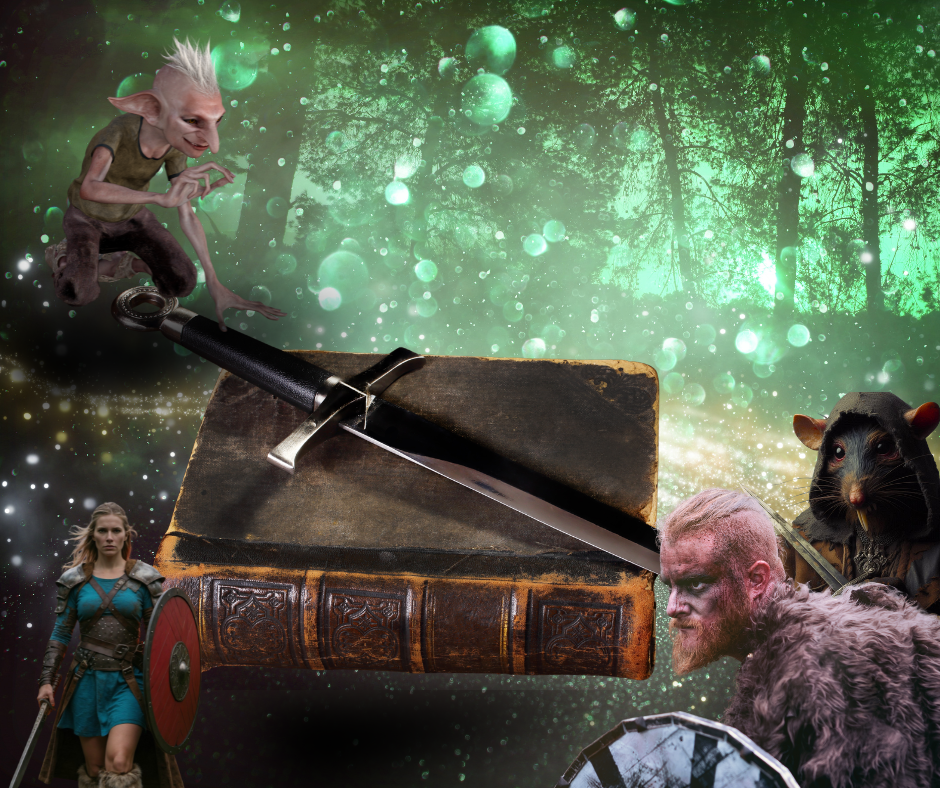
There is a correlation between sword and pen… flow state for one. This mindset of being outside of your conscious mind and trusting your subconscious is truly a powerful state of mind and I’m happy to say that I get to experience flow both with story and with a sword in my hands.
Why? Because I write and because I practice medieval style fencing. My favorite weapon form is rapier and dagger. But I do know how to fence with a sword in each hand or sword and buckler or single sword, etc.
See, when I pick up my sword, I am not rehearsing choreography. I am stepping into something unscripted. Not staged movements. Not pre-planned exchanges. I experience live decision-making under pressure. I am reading distance, adjusting balance, reacting to intent before the strike fully forms. I function in flow. And I experience what happens when flow falls away.
An Example of Swordplay in my Writing
That practical experience from both participating in tournaments, practices, and melees shape my fight scenes in Heart of the Worlds. I see the body mechanics. Hips generate force. Footwork determines survival. Overcommitment creates openings. You want to control the fight. You want to control the timing. You want to create openings and capitalize on a well-timed action that ends the fight.
Taking my experiences behind the sword and on the field has helped me create realistic feeling fight scenes in my stories.
One example I can easily give is when Mathias faces the Da Vennen, a mercenary religious sect in Faeries Don’t Forgive.
This incident takes place during the first pinch point in the plot, before the midpoint with the setting being a small steel-forging city near iron camps. Mathias and his friends are trying to find word of what happened for one of his unit and they have been getting the runaround. And then, Mathias discovers an old enemy who has laid a trap for him and his friends. Da Vennen soldiers attack.
As I worked on this interaction, I considered probable strategies from both sides and what mind-sets and body mechanics would be implemented. Since Mathias is separated from his friends and has several soldiers sprinting for him, he gravitates toward the square’s well to help him guard his left flank. The soldiers, however, believe they have the numerical advantage and feel cocky. They rush forward. Between that and having the well crowd their dominate side, Mathias has some opportunity to time his movements so he’s fighting one opponent at a time. I don’t have Mathias doing any crazy deep lunges or anything that would leave him exposed. Instead, he’s fighting more defensively, using his footwork to his advantage, and using counter attacks with his deflecting moves. In fact, one movement has him catching a blow and making his opponent’s sword slide off and down using the Da Vennen’s own momentum.
It was satisfying having one of my sparring partners read this particular section and tell me they could see the exact exchange!
Writing Fight Scenes
Writing fight scenes are a lot of fun. You can show so much character by if they know how to manage angles, read postures… along with the interiority of mindset, the sensation of adrenaline pumping through the bloodstream and how fatigue creeps over shoulders, wrists, and arms.
Experience with Melee
As I’ve mentioned I’ve had opportunity to fight shoulder to shoulder within melees which have anywhere from two to several hundred on a side.
And in larger melees — fighting shoulder to shoulder inside formations — I’ve experienced what it means to be part of something bigger than yourself. I know the sensation of chaos surrounding and how trained fighters move with intention (while newer ones either hesitate or put themselves too far into harm’s way). Anyway, that sense of disciplined motion under pressure helps me when I write battle scenes… whether it’s wererat attacks in front of a pegasi flyer tower or an aerial battle between pegasi flyers and wyverns.
Where do I have opportunity to do melee?
Through the SCA (Society for Creative Anachronism). The biggest melees happen during an event called the Pennsic War which is located in Pennsylvania. This is where there are hundreds on a side for the field battle, the woods battle, bridge battle, etc. You get pressing lines. Shouted commands. Plans falling apart. And what a core group inside a small unite within the larger “army” looks like.
I’ve worked inside these small units. I’ve also led one—a mercenary household that prides itself on going into situations “angels fear to tread.” The culture is while looking across the field and seeing superior numbers, we don’t panic. We call it a target-rich environment.
That mindset—disciplined boldness in the face of overwhelming odds—has shaped some of how I write battles in Heart of the Worlds. Inside large-scale conflict, chaos is real. Lines collapse. Flanks fail. Dust rises. Communication breaks. And yet within that, small units move with purpose. Individuals make split-second choices that ripple outward.
How is all of this not dangerous?
We do a lot to make sure everyone stays safe. Weapons are checked. Tips secured. Edges blunt. Fighters are trained in calibration. What that means is the expected force or hit you give to your opponent. In my region we call it touch calibration. If you feel it, you take it. That means you call yourself dead or maimed based on where you were struck. Yes, it is an honor system, and it works because the culture depends on integrity. Do some people cheat? Well… maybe some do but I would say probably any not taken blows easily can be chalked up to adrenaline rush of the person not calling a blow good.
Does a hard hit happen? Yes, it is a contact sport. It happens sometimes. You apologize and try not to hit too hard again. And if you are having a heavy-handed day, the most honorable thing you can do is step away for the day.
See, we are not stepping onto that field to cause harm. We step onto it to test skill, discipline, endurance, and courage within agreed boundaries.
When I have my characters sparring, this is what they are doing. For real enemies… well, the rules change and of course the aftermath of what that feels like after shows up in my writing too.
Anyway if you want to follow along with my fencing adventures, consider signing up for my monthly Wyrd & the Wisp newsletter.
My one regret about leaving Apex, Tammy, was that I didn’t ‘pick your brain’ about fencing. I will have to be content with what I learn through your newsletter. Congrats on all the success! Take care.
Traci
Hi Traci,
Please know you may pick my brain about fencing even if you have left Apex. 🙂