What do sylphs look like? Paracelsus from the 15th century AD believed sylphs “were rougher, coarser, taller, and stronger than humans” but they could also become invisible in the air. He also believed these air elementals were most similar to humans. Elementals move easily through their own elements and both sylphs and humans move effortlessly through air. They also both burn in fire, drown in water and get stuck in earth.
Many literary and occult works have been inspired by Paracelsus’s concept but as 19th century author, Robert Alfred Vaughan noted:
that “the wild but poetical fantasies” of Paracelsus had probably exercised a large influence but as time went on, his
stories had been reduced to “machinery for the playwright” and “opera figurantes with wings of gauze and spangles.”
In other words, the concept has moved into myths and legends. It’s interesting to note that Sylphs have gotten smaller over the years. According to W.Y. Evans Wentz (born 1878 and died 1965) in his book, The Fairy Faith in Celtic
Countries:
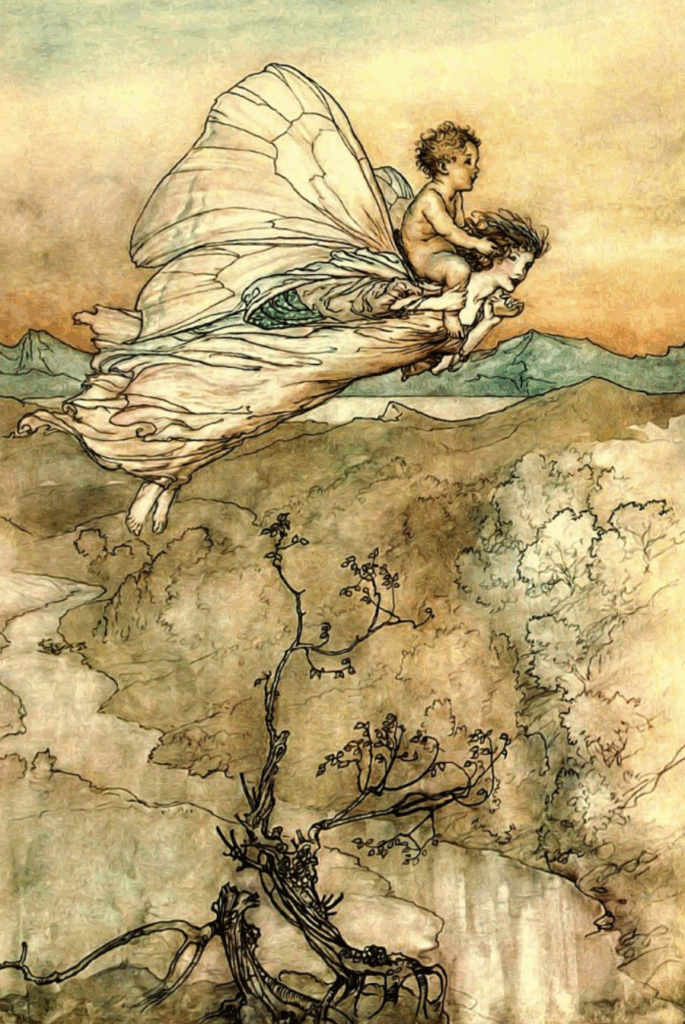
…Sylphs, commonly described as little spirits like pygmies in form, correspond to most of the fairies who are not of the
Tuatha De Danann or ‘gentry’ type, and who as a race are beautiful and graceful. They are quite like the fairies in
Shakespeare’s Midsummer-Night’s Dream; and especially like the aerials in The Tempest, which, according to Mr. Morton Luce, a commentator on the drama, seem to have been shaped by Shakespeare from his knowledge of Rosicrucian occultism, in which such spirits hold an important place.
domain
Elizabethan/Jacobean time period
Closer to Paracelsus’s time, Elementals were seen during the Elizabethan/Jacobean time period as either the agents of the devil or of God, while scientists and philosophers, saw them as elements of nature that could be brought under the control
of the learned. Ariel in the Shakespeare play THE TEMPEST is of the scientific model – a spirit controlled by a learned man.
I’m curious how much influence Paracelsus had with Shakespeare. This is based on the medical knowledge Shakespeare presented in his plays. He and Paracelsus, while not being contemporaries, were not too removed. Paracelsus died in 1541 while Shakespeare’s birth happened 23 years later. I would assume that Shakespeare knew of Paracelsus’ work and Shakespeare’s sylvan character, Ariel, had been modified to look more human.
Satirizing Rosicrucian writings
One of the best-known discussions of sylphs comes with Alexander Pope, an English poet, translator, and satirist of the Enlightenment in his satirical poem, Rape of the Lock published in 1717. This is about a young woman, Belinda, having her hair cut during a social gathering. In this piece, Pope satirizes the alchemical French Rosicrucian writings by inventing a theory that sylphs are created from angry and vain women. Belinda, the heroine of Pope’s poem, is attended by a small army of sylphs, guarding Belinda’s hair.
Greek Mythology
So where did Paracelsus get his ideas about the air elementals? I imagine he probably used source material based on Greek and Roman mythology. In fact the name Sylph is likely to come from the Greek word silphe, which means butterfly.
In Greek mythology, creatures of the air were known as the Anemoi, or gods of the winds. It’s interesting to see as well that Ptolemy world map known to Greco-Roman societies in the 2nd century (the 1540/42 edition) had 12 winds listed on around its borders.
These would be Septentrio (N), Aquilo (NNE), Vulturnus (NE), Subsolanus (E), Eurus (SE), Euroauster (SSE), Austeronotus (S), Euronotus (SSW), Africus (SW), Zephirus (W), Eurus (NW), Circius (NNW).
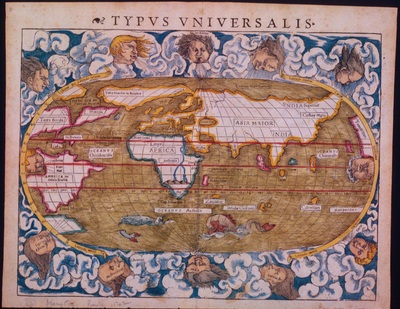
And just because I’m a Library of Alexandria super-fan, I’ll add the earliest surviving manuscripts of Ptolemy’s book Geography with its map is traditionally credited to Agathodaemon of Alexandria.
But versions of sylphs are seen elsewhere. In Germanic folklore, there were wind sprites, believed to be responsible for the changing of the seasons. And Sylphs have been prominent in French romantic literature. They are often portrayed as beautiful and delicate creatures.
Heart of the Worlds
There are definitely more deeper dives to take in our histories on Sylphs but I’ll end this piece with a quick wrap-up of Sylph manifestation in my worlds where you would find the Great Sylph Zevara, Lady of Pavari, the Court of Spring and Air. There’s a short story she’s featured in inside the Whirl of the Fae: Myths, Legends and Secrets.
She also makes an appearance in the upcoming Faeries Don’t Forgive where she continues being pulled in different directions trying to figure out how to best protect her people while being true to her particular path.