“Salamanders have been seen in the shape of fiery balls, or tongues of fire, running over the fields, or peering in houses” – Paracelsus, a 16th century alchemist.
There are quite a few myths about the Fire Salamander like they’re the ones to be credited for teaching human kind to make fires. But I’m going to start this rabbit hole with Paracelsus, one of the forefathers of modern medicine.
He is the one, most will say, who first mentioned elementals, creatures or spirits who embody the four elements: Sylphs for the Air, Gnomes for the Earth, Salamanders for Fire, and Undines for Water. And this, of course, helped to perpetuate and exaggerate the myths about this creature. But he didn’t start it.
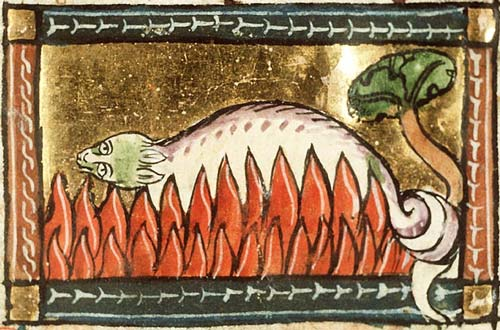
The oldest known writings about Fire Salamanders come from Aristotle, a 3rd century BC philosopher, who claimed that this creature could survive being put to the flames and was so cold that it could extinguish fire itself. This claim was later repeated—with some skepticism— by 1st century AD, Roman naturalist Pliny the Elder. He threw a salamander into fire, to the creature’s dismay, to prove Aristotle’s claims. The fire lizard probably did not survive and in a way it’s sort of ironic that Pliny the Elder died during Vesuvius’ eruption which buried Pompeii.
One of Pliny the Elder’s books, Natural History, has survived. It’s a catalog for many
topics, including zoology and describes the salamander as follows:
It is so chilly that it puts out fire by its contact, in the same way as ice does. It vomits from its mouth a milky slaver
[saliva], one touch of which on any part of the human body causes all the hair to drop off, and the portion touched
changes its color and breaks out in a “tetter,” a sort of itchy skin disease.
Another ancient influencer, Aelian, a Greek-speaking Roman author from the late
2nd–early 3rd century CE, wrote:
[The salamander’s] haunts are among artisans and craftsmen who work at the forge. Now so long as their fire is at full blast
and they have it to help their craft and to share their skill,they pay not the smallest attention to this animal. When
however the fire goes out or languishes and the bellows blow in vain, then at once they know full well that the aforesaid
creature is working against them.
Breaking some of this apart, first I would agree with many others who believe that the fire salamander originally got its reputation of having power over fire because they would hide in damp logs and when said damp logs were tossed on a fire, they would, of course, scurry out.
To take it when step further. It is incredibly likely that when one puts damp logs on a fire then said fire would die. But the belief in the fire salamander has proof. For example, a bas-relief of a salamander straddling the crossbeam of the scales in the anvil and forge, was found in the ruins of Pompeii. A well-known professor Lilian Bodson Bodson identifies the animal as Salamandra Salamandra, (not a typo), a well-known fire salamander, and suspects it was the blacksmith’s sign
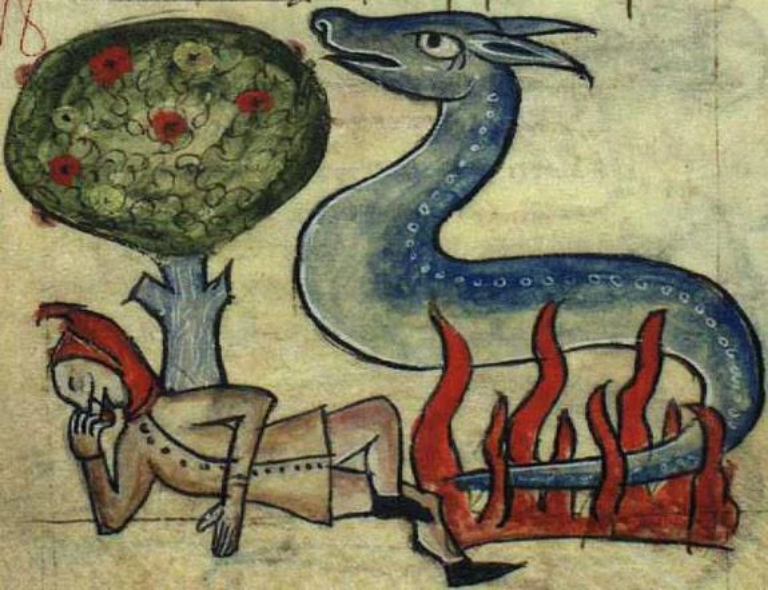
Fire salamanders are also reportedly fierce. According to Aberdeen Bestiary manuscript from around 1200 (and translated by Colin McLaren):
Of all poisonous creatures, it has the strongest poison. Other poisonous creatures kill one at a time; it can kill several
things at the same time. For if it has crawled into a tree, it poisons all the apples and kills those who eat them. In
addition, if it falls into a well, the strength of its poison kills those who drink the water. It resists fire and alone
among creatures can put fires out. For it can exist in the midst of flames without pain and without being consumed by
them, not only because it does not burn but because it puts the fire out.
Other sources about these creatures include the Talmud which claims that smearing the blood of a salamander on yourself could make you immune to the dangers of fire.
And then there’s an accounting by Marco Polo in 1250 CE, about a fire-proof garment he was told about by Zurficar, a Turk. It was made allegedly out of a salamander wool that they found:
“by digging in that mountain till they found a certain vein. The substance of this vein was then taken and crushed, and
when so treated it divides as it were into fibres of wool, which they set forth to dry. When dry, these fibres were pounded in a great copper mortar, and then washed, so as to remove all the earth and to leave only the fibres like fibres of wool. These were then spun, and made into napkins. When first made these napkins are not very white, but by putting them into the fire for a while they come out as white as snow. And so again whenever they become dirty they are bleached by
being put in the fire.” – Polo, Marco, The Travels of Marco Polo; translated by Henry Yule, 1920
This skin,or rather salamander wool, has been reasonably identified as asbestos.Then there is Leonardo Da Vinci’s account for another curious characteristic to the fire salamanders. He alleges that the creature has
“no digestive organs, and gets no food but from the fire, in which it constantly renews its scaly skin.”
This belief was embraced by Paracelsus and as he upgraded the fire salamander to an elemental.
So what do fire salamanders exactly look like? One of the earliest surviving descriptions of salamanders is in Pliny the Elder from the 1st century CE. He said the creature is “a lizard-shaped animal with spots all over its body. It never comes out except during heavy rains, and leaves as soon as the weather clears.”
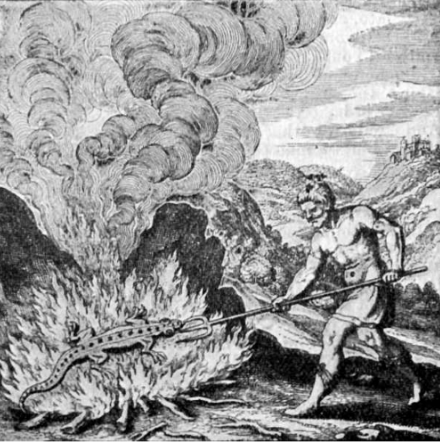
Manly P. Hall, Canadian author from the 20th century, also writes that the common form of fire lizards are lizard-like shape, a foot or more in length and typically are seen within the flames of a fire.
However, he states there are also the huge flaming giants in flowing robes with fiery armor, such as the great salamander Oromasis; the Acthnici who appear as indistinct globes and float over the water at night and can erupt as St. Elmo’s Fire on the riggings of ships; and the strongest of the fire salamanders are the Djin and sages are warned to stay far from them.
There are certainly more rabbit holes that this particular faery creature inhabits but I’ll leave off except to add a bit about them in my writings:
Narvis, a fire salamander, showed up early on in my story’s development. He is relatively young, spunky and a bit dishonest. He also definitely does not like the situation he has to grapple with or make the decision on whether to be an ally or not with my protagonist Aunia. He is also not the only fire salamander you’ll find in my series.