These Italian wind-knots, yes faeries, also known as the folletti, the folletto di vento, and/or wind sprites are elusive to research with bits scattered hither and yon. Suffice it to say their environment is predominately traveling in the wind.
They gravitate to storms and enjoy causing swirls in the dust. They can take on the form of butterflies, fly and be invisible, and\or have their toes on backwards. Some are known to take the form of little boys with castanets and silk hats and one
particular one, at times, takes the form of a grasshopper.
They can be friendly to humans but they also can be destructive, mischievous if not outright malevolent, and little preoccupied with how humans reproduce.
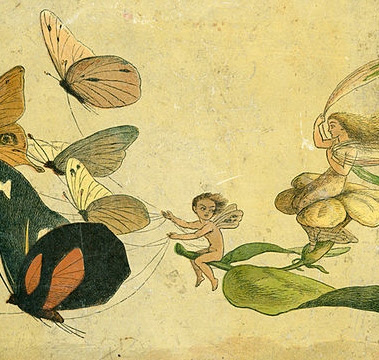
An interesting foundation to these creatures is the merging between cultures of the Romans and Celts along with melding of time from the rich tradition of pre–Christian beliefs to medieval legends. What came into being is Italian counterparts to the
gnomes, leprechauns and pixies we find in more western and northern European folklore.
I find it disappointing to find so little on these beings and I read things like “much of the Italian fairies appear to be lost except from the writings of folklorists or anthropologists or the occasional collection of folktales.”
I have found that they have been blamed for rain, snow-storms, and floods which destroy crops and homes although they also can be less malevolent and simply curdle milk or tangle horses’ tails, particularly since they are also associated with farms as much as wind and weather.
Dante’s Inferno
I did go down some interesting rabbit holes. One example I ran into was the discussion of tantalizing clues in Dante’s Inferno. In Canto 30 of the Inferno, it opens up with:
…withered souls of the impersonators, who have lost all use of their intellectual faculties… One of them sinks his teeth into
the alchemist Capocchio’s neck and drags him bodily across the ground. The alchemist who remains, Griffolino, then identifies the mad soul to Dante and Virgil by using a particular word: “Quel folletto è Gianni Schicchi” (Inferno 30, v. 32).
The article notes that Folletto is a peculiar way to describe a damned soul as it denotes a spirit of the air aka Wind-Knot.
Despite how both medieval commentators and modern scholars viewed this term (and it was not the same), the Dante Society of America notes the usage of precise language in Dante’s Inferno, suggesting deliberate use of the term AND they have reasonable certainty that Dante would have been aware of common folklore in his environment.
For My Deep-Diving Readers:
In the folk imagination, the folletto was a type of imp or goblin that lived in the air, and like other fairy creatures it was capable of influencing the weather.[15]In many descriptions of folletti, there appears an impish, almost playful quality,
even committing pranks that could not be cast as malevolent.
[16] Folletti tended to be invisible and childlike, appearing in twirls of wind. They might be responsible for gusts that
knocked hats off people’s heads, and twirled women’s hair into knots.
[17] That said, folletti were not to be taken lightly. They belonged to the same species as the dark angel that torments the corpse of Bonconte da Montefeltro in Purgatorio 5.
[15] Richard Firth Green, Elf Queens and Holy Friars: Fairy Beliefs and the Medieval Church, 38.
[16] Franca Romano, “Il folletto innamorato: Folletti e adolescenti nella cultura tradizionale italiana,” La ricerca
folklorica 34 (Ottobre 1996): 73-74.
[17] Giovanni Tassoni, Folklore e società: Studi di demonologia padana (Firenze:Olschki, 1977): 88.
So What Do You Do If You Find Yourself Being Harassed by Forces of the Wind?
I mean who hasn’t experienced having one’s hair tangled with fairy knots? Have you been accosted? According to a passage in Arrowsmith, Field Guide to the Little People, you may want a brown-haired girl to run them off. They are said to have that ability. And you may want to avoid Sicily which has the most numerous and dangerous wind knots, according to Arrowsmith. It has one of the most violent climates in the Mediterranean.
What’s in a Name?
Arrowsmith also notes that “many winds get their names from the Folletti who travel in them and many of the Folletti are named after the winds they ride.”
My thought to that is what a chicken and egg puzzle. I mean, which one came first?
More Tales & Maybe a Mischievous Wind Knot.
According to TOWER LEGENDS by Bertha Palmer Lane in 1932:
NO ONE has ever seen the goblin of Giotto’s Tower, though many have heard its voice and any flower vender, in the busy square in Florence where the tower stands, can tell you the legend…
When one mounts the stairs of the tower, a gentle voice is heard below, saying:
“Go on, go on, Signora,
Go up the stairs,–oh, go!
Be not afraid, my Lady,
For I am here below.”
The tale continues in www.strangehistory.net though I’m curious to their source.
Then the visitor hearing this believes it is one of the guides employed or one of the gentlemen or ladies who are ascending
after. And often when half-way up there comes a great puff of wind which blows up their skirts which causes great laughter,
and they think that this is only a common thing, and do not perceive that it does not happen to others.
Research Treasures & a Nod to Faeries Don’t Lie.
I was thrilled to discover the Pentamerone, one of the oldest known fairy tale collections and a huge influence to other famous storytellers, including the Brothers Grimm. I now have that bookmarked.
And a little tidbit: An incarnation of the Italian Wind Knots have found a home inside my worlds of Ahnu-Endynia. There’s a sighting of some in my first book!